Ciena’s CEO expects a large portion of hyperscalers’ capital spend will be on network infrastructure
Key Highlights
- Hyperscalers' capital expenditures are expected to surpass $720 billion in 2026, primarily driven by AI infrastructure needs, boosting demand for optical networking gear.
- Ciena anticipates a larger share of network infrastructure spending as hyperscalers and service providers upgrade their optical and fiber networks post-5G deployments.
- The company is expanding its customer base for innovative solutions like DCOM and RLS hyper-rail, which are tailored to meet the bandwidth and operational demands of cloud and AI infrastructure.
- Ciena’s revenues grew 40% year-over-year to $1.57 billion, with optical networking and routing segments leading the growth, supported by strong demand from cloud providers and service providers.
- Future forecasts indicate continued growth, with projected revenues of around $1.63 billion for Q3 2026 and an annual revenue target of $6.3 billion, reflecting confidence in market expansion.

Keep up to date with Lightwave’s Q1 2026 earnings coverage.
You can check our publication’s key segments:
And
Here are other stories on Ciena:
- Ciena’s CEO sees MOFN as a key service provider growth segment
- Ciena’s CEO said telcos had underinvested in their networks
- Ciena shutters broadband PON plans to focus on cloud and data center network opportunities
- Ciena’s fiscal Q2 dominated by cloud provider demands
- Ciena’s CEO says the service provider is over its inventory digestion phase
- Ciena’s service provider triumph
Ciena is keen on riding the hyperscaler community capital spending wave, which is set to gain momentum throughout 2026 and will require more optical networking and routing gear to meet bandwidth demands.
After hitting $388 billion in 2025, the top five hyperscalers' capital spending is estimated to reach over $720 billion (up 36%), driven almost entirely by demand for AI infrastructure.
Leading the charge will be Amazon with an estimated $200 billion. Not far behind Amazon will be Google/Alphabet (GOOGL) ($175 -$185 billion), Microsoft ($190 billion), Meta ($125-$145 billion), and Oracle ($50 billion).
Gary Smith, CEO of Ciena, told investors during the company's fiscal second-quarter earnings call that a significant percentage of spending will be on the optical and networking platforms it sells.
“Since we spoke to you last in March, the largest hyperscalers have increased their 2026 capital expenditures, with indications of continued expansion into 2027 and beyond,” he said. “Given the priority to monetize somewhat constrained compute investments, we expect an increasingly larger proportion of that spend will be directed towards network infrastructure.”

Service providers reignite investments
But hyperscalers are only one angle that’s got Ciena excited. Ciena noted a resurgence in traditional service provider spending, which was up 28% year-over-year.
“Service providers are also reinvesting in network infrastructure after several years,” Smith said. “This is creating net new opportunities with service providers across long-haul metro and managed optical fiber networks or MOFN.”
Smith added that, on the one hand, service providers are prioritizing new investments in their wireline optical networks as they complete their wireless 5G network builds.
“One is that they have basically underinvested in their optical infrastructure for the last 5 years,” he said. “They've been very preoccupied with 5G investments. That's obviously now tailing off. And they are looking to put their optical infrastructure up to date, and that's a development we're seeing across the service provider landscape worldwide.”
Additionally, more service providers are deploying managed optical fiber networks (MOFNs), dedicated, high-capacity optical connections built and operated by third parties for a single enterprise or cloud client.
While Ciena is not alone in the MOFN segment, with competitors such as Adtran, Nokia, and Ribbon offering similar solutions, the model has become more popular among service providers, as it bridges the gap between buying standard lit services and leasing dark fiber, offering exclusive bandwidth and security without operational or specialized staffing burdens.
“The second dynamic we're seeing is the MOFN piece, which is managed optical fiber networks built explicitly for hyperscalers and for cloud players in various countries,” Smith said.
DCOM, RLS momentum grows
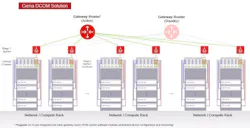
Across the hyperscalers and service provider segments it serves, Ciena is seeing growing momentum around its data center out-of-band management solution (DCOM) and RLS (Reconfigurable Line System) Hyper-Rail solutions.
DCOM, which combines products from Ciena’s routing and switching portfolio with its PON technology, continues to ramp, contributing to the 88% year-on-year revenue growth in its Routing and Switching segment.
Although he could not reveal specific names, Smith said it is expanding the DCOM customer base.
“In addition to Meta, we've received initial orders from a second hyperscaler customer, and lab qualifications are progressing well with a third hyperscaler customer,” he said.

Meanwhile, Ciena is seeing similar gains with its RLS (Reconfigurable Line System) Hyper-Rail, a specialized optical networking solution designed to meet the massive bandwidth demands of modern, geographically distributed AI and cloud infrastructure.
Having built a global installed base for its RLS platform, Ciena gained insights into the technology requirements, as well as operational expertise and integration experience across both cloud and service provider environments.
The experience Ciena gained with its RLS platform deployments influenced the development of its next-generation intelligent line system, the RLS hyper-rail.
Co-created with multiple hyperscalers, RLS hyper-rail supports multiple fiber pairs in parallel over hundreds of kilometers using advanced amplification, resulting in higher density with materially improved space and power efficiency, which is particularly important at intermediary amplifier sites where space and power are limited.
Smith noted that it has started signing up hyperscaler customers for the RLS hyper-rail platform.
“We’ve been awarded a multi-rail order from a leading hyperscaler, validating early market demand for our RLS hyper-rail platform and cementing Ciena's position as the industry standard,” he said. “We are also engaged in discussions with multiple additional hyperscalers, neoscalers, and service providers, both domestically and internationally, who continue to lean in and show interest exceeding our expectations.”

Optical networking and routing lead revenues
Driven by gains in its optical networking and routing and switching lines, Ciena’s revenues reached $1.57 billion, up 40% year-on-year and $71 million over its guidance, setting what it said was another quarterly record.
Due to strong demand for its RLS and Waveserver product lines, both up over 55% year-on-year, optical networking grew 42% over the second quarter of 2025 to $1.1 billion.
Likewise, Ciena’s routing and switching business grew 88%, due to the ramp of DCOM.
Marc Graff, CFO of Ciena, noted that “our direct cloud customer revenue grew 70% over the year-ago period, with service providers growing 28%.”
He added that “our India service provider revenue more than doubled year-on-year, reflecting strong demand for MOFN deployments.”
However, Blue Planet Automation Software and Services was $23.4 million, down from $28 million in the same period last year.
Looking forward, Ciena has forecast third-quarter 2026 revenue of about $1.63 billion, plus or minus $50 million.
“Based on our first half performance and continued ability to manage through a supply-constrained environment, we are once again in a position to raise our guidance for fiscal '26,” Graff said. “We now expect to deliver revenue for the fiscal year of $6.3 billion, plus or minus $100 million, raising our midpoint growth to 32% year-on-year.”
For related articles, visit the Business Topic Center.
For more information on high-speed transmission systems and suppliers, visit the Lightwave Buyer’s Guide.
To stay abreast of fiber network deployments, subscribe to Lightwave’s Service Providers and Datacom/Data Center newsletters.
About the Author
 Sean Buckley
Sean Buckley
Sean is the Editor-in-Chief of Lightwave. He establishes and executes Lightwave's editorial strategy across its website, email newsletters, events, and other information products. Before coming to Lightwave in July 2023, he served as editor of Broadband Communities. Earlier, he served as senior editor of FierceTelecom and the editor of the former Telecommunications Magazine. He got his start in the optical industry in 1998 when he became the editor of enterprise and optical networks at Information Gatekeepers. He has a BA in English from the University of Massachusetts, Boston, and lives in Dracut, Mass, with his wife, two sons, and his cat, Dove.