Optimum’s CEO says broadband and mobile convergence momentum continues to build

Keep up to date with Lightwave’s Q1 2026 earnings coverage.
You can check our publication’s key segments:
And
Here are other stories on Optimum:
Optimum’s move to offer customers the ability to bundle broadband and mobile services, appealing to price-conscious consumers, is enabling it to create long-term value in customer relationships.
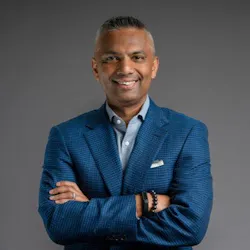
Dennis Mathew, CEO of Optimum, said that bundling broadband with mobile gives customers a one-stop shop for their services.
“Our broadband and mobile convergence momentum continues to build as customers increasingly look for simplicity, value and a single provider for their connectivity needs,” he said. “Broadband remains the anchor product in the home, while mobile plays a critical role in enhancing that value. By bundling mobile with broadband, we're increasing customer stickiness, improving retention and driving higher lifetime value.”

One of the key promotions it launched during the quarter was its UnBig Your Bill campaign, a retail promotion that enables AT&T and Verizon customers to lower their monthly mobile costs. Customers who bring their current phone bill to an Optimum store will have their team complete a price comparison; if they can't save the customer money, Optimum Mobile will provide a $150 gift card.
Mathew said its mobile growth is supported by continued improvement in its go-to-market execution, “including stronger sales quality, better experience, more competitive offers with everyday low pricing and discounts on broadband and a focus on multiline adoption, all of which are driving higher value customer additions.”
He added that “this is reinforced by our recently launched UnBIG Your Bill campaign, which highlights meaningful annual savings compared to the major carriers.”
Convergence base deepens
Optimum’s strategy to target its broadband customers with mobile services continues to bear fruit, with penetration rising nearly 9% in the first quarter.
This comes as Optimum continued to enhance its base of mobile subscribers.
During the quarter, Optimum added 52,000 net mobile lines, which the company said was its strongest quarterly performance in six years, bringing the total to 674,000.
Likewise, residential mobile service revenue grew 35% year over year to $50 million in Q1 2026, compared to $37 million in the first quarter of 2026.
Mathew said the service provider sees a significant opportunity to deepen its mobile bond with existing broadband customers.
“While we have steadily grown convergence in our base, we still see significant runway to continue to drive mobile attachment and deepen penetration among existing customers,” he said. “More broadly, our entry offer plus attach model is central to our strategy and how we go to market. Every new broadband customer is an opportunity to deepen the relationship and attach mobile, video, Whole Home WiFi, Total Care, or other value-added services. This approach allows us to balance more competitive entry pricing with stronger lifetime value.”
Convergence ARPU grew 1.2% year-over-year to $79.32.
The service provider’s convergence ARPU is calculated by dividing the average monthly revenue from broadband and mobile services by the average number of residential broadband relationships, excluding mobile-only customers.
Marc Sirota, CFO of Optimum, said the company expects convergence ARPU to become a key metric for evaluating the business.
“We will continue to balance rate and volume throughout the course of the year as we push to improve the underlying trends on broadband customer results. We do anticipate pressure on ARPU in the full year, particularly from broadband growth additions as we focus on prioritizing volume stabilization and multiproduct penetration,” he said. “We believe this shift will ultimately drive stronger attach and improve the overall value of the customer relationship, supporting more durable revenue and ARPU growth over time.”
Fiber migration continues
In addition to scaling mobile, Optimum continues to expand its fiber-to-the-home (FTTH) network reach. Over the past three years, it has expanded its network by over 500,000 homes passed.
We remain focused on building fiber, selling fiber and continuing to migrate customers organically within our base, having expanded our network by over 500,000 homes over the past three years.
Optimum added 38,000 total new passings in the first quarter and +190k total new passings in the last twelve months. On these fiber networks, about 96% of the total footprint has 1 Gbps or higher speeds available
It also continues to ramp up its fiber customer base, adding 13,000 fiber customers in the quarter, bringing its total to 729,000, up over 20% year-over-year.
A key focus for Optimum is bringing on customers in new communities where it is building fiber, rather than migrating existing HFC customers to fiber.
“While fiber migration remains an important part of our long-term road map, we are currently prioritizing new builds and new broadband customer trends over migrations of existing customers to fiber,” Mathew said. “Over time, we expect to re-engage more proactively to transition customers to fiber. But in the current environment, we are focused on investing where we see the highest near-term returns and greatest impact on long-term value creation.”
Broadband struggles, opportunities
During the first quarter, Optimum struggled with broadband, losing 64,000 customers, or 56,000 excluding a subscriber adjustment related to prior periods.
The service provider ended the quarter with 4.1 million broadband subscribers.
Despite the losses, Optimum is seeing more of its broadband customer base migrate to higher-speed tiers, with 47% of the base taking 1 Gbps or higher speeds at the end of the first quarter of 2026, up from 21% in the first quarter of 2023.
A big contributor to its broadband troubles in the first quarter was a rise in fixed wireless access (FWA) and fiber overbuilders offering a host of new pricing and subscriber perks, such as fixed pricing.
“Across our footprint, ILECs, fixed wireless providers, and fiber overbuilders all continue to lean aggressively into lower entry pricing, extended price locks, and promotional incentives,” Mathew said. “In the West, in particular, the competitive profile has shifted considerably with the expansion of fixed wireless availability as well as fiber overbuilders further intensifying market dynamics in an already challenging landscape. This is the backdrop against which we are executing.”
He added that “Our response has been to simplify and establish a more consistent and competitive product and pricing structure across our footprint.”
Optimum reported that total first-quarter revenue was $2.07 billion, down 4% year over year, with residential revenue down 6.5% year over year to $1.56 billion.
For related articles, visit the Business Topic Center.
For more information on high-speed transmission systems and suppliers, visit the Lightwave Buyer’s Guide.
To stay abreast of fiber network deployments, subscribe to Lightwave’s Service Providers and Datacom/Data Center newsletters.
Optimum surpasses the 700K mobile line mark
Optimum Communications recently surpassed 700,000 mobile lines, reflecting strong customer demand for affordability as it expands savings on bundled services. According to a recent national survey conducted on behalf of Optimum, 79% of consumers have reduced spending in the past two months, with 30% reducing spending on either TV, Mobile, or Internet services. As households continue to look for smarter ways to manage essential expenses, affordability has become an increasingly important driver of connectivity choices.
About the Author
 Sean Buckley
Sean Buckley
Sean is the Editor-in-Chief of Lightwave. He establishes and executes Lightwave's editorial strategy across its website, email newsletters, events, and other information products. Before coming to Lightwave in July 2023, he served as editor of Broadband Communities. Earlier, he served as senior editor of FierceTelecom and the editor of the former Telecommunications Magazine. He got his start in the optical industry in 1998 when he became the editor of enterprise and optical networks at Information Gatekeepers. He has a BA in English from the University of Massachusetts, Boston, and lives in Dracut, Mass, with his wife, two sons, and his cat, Dove.