Verizon advances its Carrier Ethernet standing amidst M&A market shuffle
Key Highlights
- Verizon's acquisition of Frontier significantly expanded its fiber network, elevating its market position to #2 in the U.S. Carrier Ethernet rankings.
- AT&T maintains its leadership with extensive fiber deployment across 440,000 properties and a planned $250 billion investment through 2030 to modernize its network.
- Zayo advanced to the leaderboard after acquiring Crown Castle and plans to add 15,000 route miles by 2030, strengthening its long-haul network.
- Market shifts include declines for some cable MSOs and the rise of Zayo, with other providers like Cogent and Granite also gaining recognition in the Challenge Tier.
- DIA remains the dominant Ethernet service, with enterprise customers shifting towards SD-WAN and SASE for more flexible, secure connectivity solutions.

Verizon has advanced its footing in the U.S. Carrier Ethernet market, a factor attributed to the completion of its Frontier acquisition earlier this year.
By purchasing Frontier, Verizon immediately expanded its presence with a fiber network spanning over 160,000 route miles to support high-capacity enterprise and wholesale.
Before Verizon purchased it, Frontier invested $4.1 billion to upgrade and expand its fiber network and now derives more than 50% of its revenue from fiber products.
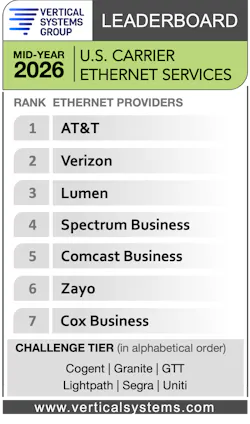
As a result, Verizon moves up from the #4 position to the #2 rank with its completed acquisition and integration of Frontier assets on Vertical Systems Group’s Mid-Year 2026 U.S. Carrier Ethernet LEADERBOARD.
However, for all the momentum Verizon has gained, AT&T remains the player to beat, retaining its number one rank on VSG’s LEADERBOARD.
AT&T continues to expand its fiber network. In June 2026, it announced that over 40 metro areas offer its 400G wavelength connectivity, with availability across 440,000 properties and more than 2.3 million business tenants. As it expands its wavelength offerings, AT&T has more opportunities to strengthen its Ethernet presence in the U.S.
Overall, AT&T plans to spend more than $250 billion through 2030 to build and modernize its network, part of a necessary modernization to replace legacy copper with more reliable, resilient fiber to support critical applications such as enhanced 911 services and, of course, more AI.

Market shifts
As Verizon’s ranking rises on VSG’s LEADERBOARD, other providers saw either a lower ranking or an upward move.
The research firm noted that the rankings changed for four of the seven Ethernet LEADERBOARD providers.
With Verizon’s expansion via Frontier, Lumen dropped from the second position to third.
Cable MSOs also shifted. Spectrum Business dropped from third to fourth while Cox Business fell to the seventh and final position.
VSG noted that the “acquisition of Cox by Spectrum’s parent company, Charter Communications, was completed in August 2026 and is not included in the mid-year results.”
Meanwhile, Zayo advanced from the Challenge Tier onto the LEADERBOARD, gaining a sixth position due to its acquisition of Crown Castle, which was completed in May 2026.
Besides its acquisition of Crown Castle, Zayo is not standing pat. In August, Zayo signed a deal with Corning to secure a major portion of the fiber cable required for its long-haul network expansion throughout the remainder of the decade.
“Deepening our relationship with Corning gives us greater confidence that material availability won’t stand between customer demand and the infrastructure required to deliver it,” said Steve Smith, CEO of Zayo.
As part of this network build, Zayo intends to add 15,000 new route miles by 2030 to its network, one it describes as “one of the largest network expansions in its history.”
Outside of the top LEADERBOARD, six companies attained a Challenge Tier citation: Cogent, Granite, GTT, Lightpath, Segra, and Uniti.
The Challenge Tier includes providers with between 1% and 4% share of the U.S. retail Ethernet market.
Segra, which was a subsidiary of Cox and now Charter, entered the Challenge Tier, moving up from the Market Player tier.
DIA remains dominant
Within the Ethernet services market, DIA (Dedicated Internet Access) remains the dominant service in the U.S. based on both ports and revenue.
Large businesses prefer DIA for carrier-grade SLAs and strong backbone connectivity to avoid middle-mile issues.
Enterprise customers are shifting from lower-speed Ethernet private lines to more robust SD-WAN and SASE services. DIA services are premium-priced, as they provide customers with secure, dedicated symmetrical access.
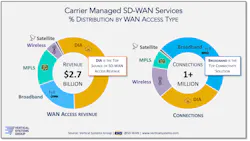
VSG noted in a recent STATFlash, U.S. SD-WAN Access Revenue and Connections, that DIA is the top source of SD-WAN Access revenue, accounting for more than half of the $2.7 billion 2025 base.
Trailing DIA are broadband and MPLS.
With a lower monthly cost than DIA and MPLS connectivity, broadband is the second-largest source of SD-WAN Access revenue.
MPLS has the third-largest managed SD-WAN revenue base, and the highest average monthly pricing across all WAN access solutions. As a premium-priced service, MPLS meets customer requirements for security, reliability, and predictable application performance, backed by Service Level Agreements.
And while wireless and satellite are also used, revenues trail DIA and other connectivity options for SD-WAN. Wireless services offer asymmetrical connectivity to support lower-bandwidth applications.
Likewise, satellite revenue for U.S. SD-WAN Access services is minimal and predominantly focused on rural customers.
For related articles, visit the Business Topic Center.
For more information on high-speed transmission systems and suppliers, visit the Lightwave Buyer’s Guide.
To stay abreast of fiber network deployments, subscribe to Lightwave’s Service Providers and Datacom/Data Center newsletters
About the Author
 Sean Buckley
Sean Buckley
Sean is the Editor-in-Chief of Lightwave. He establishes and executes Lightwave's editorial strategy across its website, email newsletters, events, and other information products. Before coming to Lightwave in July 2023, he served as editor of Broadband Communities. Earlier, he served as senior editor of FierceTelecom and the editor of the former Telecommunications Magazine. He got his start in the optical industry in 1998 when he became the editor of enterprise and optical networks at Information Gatekeepers. He has a BA in English from the University of Massachusetts, Boston, and lives in Dracut, Mass, with his wife, two sons, and his cat, Dove.