Optimum’s bulk broadband pivot drives its MDU subscriber increase
Key Highlights
- Optimum shifted from nonexclusive to bulk agreements with property owners, resulting in a 9,000 broadband and 8,000 video subscriber increase in Q2.
- Fiber customer base grew by 20,000, reaching 749,000, with a 13% year-over-year increase, highlighting the importance of fiber in Optimum's strategy.
- Optimum added 50,000 new wireless lines, achieving a total of 724,000, and expanded its 5G partnership with T-Mobile to support next-generation services.
- Convergence ARPU increased by 2.4% year-over-year to $79.80, reflecting the benefits of bundled services despite overall ARPU dip due to product mix shifts.
- Revenue declined by 5.8% to $2 billion, mainly driven by challenges in residential video and advertising, but gross margins improved to 71%, mitigating revenue pressures.

Keep up to date with Lightwave’s Q2 2026 earnings coverage.
You can check our publication’s key segments:
And
Here are other stories on Optimum:
- Optimum’s CEO says broadband and mobile convergence momentum continues to build
- Optimum’s third-quarter results reflect challenges from FWA and aggressive fiber-overbuilders
- PODCAST: Optimum makes a call for smart consumer online data habits
- Altice USA to double the availability of multi-gig speeds across its network
Optimum is no stranger to the multi-dwelling unit (MDU) broadband market, one that makes up 30% of its footprint.
However, Optimum has been transitioning its agreements with MDU property managers and owners to a bulk agreement structure.
A bulk broadband arrangement is where a property owner, HOA, or management group signs a single contract with an internet service provider to supply network access to every unit in a building or community.
Optimum provides MDU broadband and Managed Wi-Fi solutions across its 21-state footprint, with the highest concentration of MDU passings and fiber infrastructure located in the New York tri-state area (New York, New Jersey, and Connecticut), alongside select markets nationwide.
Dennis Mathew, CEO of Optimum, said during the service provider’s second-quarter earnings call that while MDU broadband is a “meaningful opportunity for us,” the turning point was its transition from nonexclusive agreements to bulk.

“One of the big issues we had when I joined was that we were signing nonexclusive agreements, so we had no protection, no real ability to drive long-term value through these arrangements,” he said. “And so, starting about 12 to 18 months ago, we started to prioritize redoing existing agreements as well as all new agreements and converting them from nonexclusive and retail to bulk.”
Optimum saw the fruits of its MDU bulk arrangement transition effort pay off in the second quarter, with an uptick in both broadband and video subscribers in this segment.
“We have remained focused on strengthening our MDU subscriber business by shifting from individual customer relationships to more bulk agreements with property owners under long-term contracts,” said Marc Sirota, Optimum's CFO. “From these efforts, in the second quarter, we saw an additional 9,000 broadband connects and 8,000 video connects driven by a bulk relationship portfolio conversion.”
Broadband subscriber battles, opportunities
Optimum continues to battle a challenging environment in which fiber overbuilders and fixed wireless access (FWA) continue to impact its subscriber base.
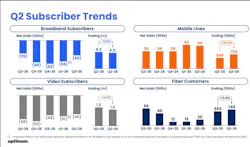
In the second quarter, Optimum lost 40,000 broadband subscribers, ending the quarter with 4 million customers.
Sirota said that “we continue to experience elevated churn primarily driven by heightened promotional activity from competitors.”
FWA competitors like T-Mobile currently offer eligible customers service starting at $35 per month with AutoPay and a voice line (plus taxes & fees), while also throwing in a Month of Internet and a choice of AirPods or up to $200 via a virtual prepaid card, for example.
Despite the losses, Optimum noted that over half of its new broadband customers chose its 1 Gbps or higher speed offerings, reinforcing the value customers see in higher-speed connectivity.
Fiber remained a shining star in Optimum’s broadband portfolio. The service provider added 20,000 customers in the quarter, bringing its total to 749,000 fiber customers, up more than 13% year over year.
“As expected, net addition trends moderated compared to the prior year, reflecting our intentional and disciplined approach to customer migrations over the last few quarters,” Mathew said. “Sequentially, however, fiber additions increased modestly, driven by incremental net new customer growth on our fiber network.”
Wireless trajectory continues
Like its larger cable counterparts, Charter and Comcast, Optimum continues to see success with its growing mobile services strategy, a trend that continued into the second quarter.
During the quarter, Optimum added 50,000 net new wireless lines, marking its strongest second-quarter results to date and growing mobile lines by about 33% year over year. What’s more, the company passed the 700,000 milestone, ending the quarter with 724,000 mobile lines.
“On mobile, we saw our best-ever second-quarter mobile trends, which increased mobile and broadband convergence penetration to approximately 9% at the end of the second quarter,” Mathew said. “We're driving higher penetration through targeted upsell and cross-sell, simplifying our offers and expanding multiline adoption, taking a customer-first, data-driven approach to streamline device financing, improve quality of sale and strengthen network quality.”
Amid gains in its wireless subscriber base, Optimum expanded its multi-year agreement with T-Mobile to access its 5G standalone network. As part of the agreement, Optimum will provide connectivity on T-Mobile’s network, enabling faster response times, improved reliability, greater network efficiency, and support for next-generation mobile services.
“By extending mobile connectivity beyond smartphones to wearables and a growing universe of connected devices, this capability substantially expands our addressable market, multiplying the number of devices and revenue streams we can serve per household and business and positioning us to capture a greater share of connectivity spend over time,” Mathew said. “Paired with our fiber network, this converged offering is expected to be a durable competitive advantage and a meaningful driver of long-term profitable growth.”
Convergence progresses
A key highlight of the second quarter was Optimum’s convergence strategy.
In convergence ARPU, a metric the service provider introduced last quarter, grew 2.4% year-over-year to $79.80. Optimum calculates Convergence ARPU by dividing the average monthly revenue from broadband and mobile services by the average number of residential broadband relationships and excludes mobile-only customers.
“We expect convergence ARPU to become an increasingly important metric on how we evaluate the business, providing a more meaningful view of customer value by capturing the combined economics of the relationship and the impact of bundling on unit economics,” said Sirota.
Sirota cautioned that as the company looks at the second half of the year, it expects tougher ARPU comparisons, “particularly in the fourth quarter, as promotional pricing held relatively steady as we benefited from rate actions at the end of 2025 and that we will continue to evaluate our go-to-market and promotional strategies and the opportunities to optimize pricing and rates, while remaining agile as market conditions evolve, throughout the second half of the year.”
However, overall residential ARPU dipped 1.1% year over year, or $1.46, due to a product mix shift away from video. Video's contribution to the year-over-year decline was just over $3, which was partially offset by non-video ARPU growth of $1.57, mainly tied to convergence.
Video, news drive revenue challenges
Due to ongoing challenges in its residential video and News and Advertising business, Optimum reported total second-quarter revenue was $2 billion, down 5.8% year-over-year.
Excluding the previously mentioned divestment of its advertising agency services business, the company said revenue would have declined 5.1% year-over-year.
“Consistent with recent quarters, residential video and our video-related News and Advertising business remain the largest driver of year-over-year revenue declines,” Sirota said. “Those businesses accounted for $92 million or approximately 75% of our revenue decline.”
He added that Optimum’s “focus with these businesses continues to be on improving profitability while looking to slow the rate of secular declines.”
Despite revenue pressure, Optimum delivered an all-time-high gross margin of 71% in the quarter, up 180 basis points year over year. This improvement was driven by revenue declines concentrating in lower-margin areas of the business, helping mitigate the revenue impact of declining video volumes.
Residential connectivity and all Other, which includes residential broadband, mobile and telephony as well as other revenue, declined year-over-year by 3.6%, reflecting broadband subscriber pressure partially offset by mobile revenue growth. Overall residential revenue was $1.54 billion, down 6.7% year-over-year.
Business Services were once again a bright spot with revenue of $366 million, up 1.2% year-over-year, driven by Lightpath revenue growth of 7%.
For related articles, visit the Broadband Topic Center.
For more information on high-speed transmission systems and suppliers, visit the Lightwave Buyer’s Guide.
To stay abreast of fiber network deployments, subscribe to Lightwave’s Service Providers and Datacom/Data Center newsletters.
About the Author
 Sean Buckley
Sean Buckley
Sean is the Editor-in-Chief of Lightwave. He establishes and executes Lightwave's editorial strategy across its website, email newsletters, events, and other information products. Before coming to Lightwave in July 2023, he served as editor of Broadband Communities. Earlier, he served as senior editor of FierceTelecom and the editor of the former Telecommunications Magazine. He got his start in the optical industry in 1998 when he became the editor of enterprise and optical networks at Information Gatekeepers. He has a BA in English from the University of Massachusetts, Boston, and lives in Dracut, Mass, with his wife, two sons, and his cat, Dove.