Plotting the middle mile fiber opportunity

Bandwidth demands from AI data centers, consumer broadband, business services and newer applications like quantum computing and fiber sensing are creating new opportunities for middle mile infrastructure.
Middle mile fiber is the high-capacity, long-haul fiber-optic infrastructure that bridges the gap between the internet's core backbone (like major data centers and internet exchange points) and local "last mile" networks.
The need for new middle-mile infrastructure will have a ripple effect by connecting not only unserved and underserved towns across the country but also lowering broadband costs for mid-sized communities.
NTIA’s Enabling Middle Mile Infrastructure Program awarded $980 million in grants to 36 organizations across 40 states and territories to deploy, lease, or upgrade existing networks in 2024. From the awards, construction began in eight states to build or upgrade nearly 1,500 miles of much-needed middle-mile fiber.
Given the diversity of needs, no two middle mile networks are the same. Today, a few main provider types are pursuing new middle mile builds:
· State initiatives: Alabama (Alabama Fiber Network), California (California Middle-Mile Broadband Initiative), Maine (MOOSE Net) and Massachusetts (MassBroadband 123) are taking matters into their own hands, building state-focused middle-mile networks. For example, in July 2021, Governor Gavin Newsom signed Senate Bill 156 into law to create an open-access middle-mile network to bring equitable high-speed broadband service to all Californians. SB 156 provides $3.25 billion to build the necessary infrastructure to bring internet connectivity to homes, businesses and community institutions.
· Traditional Telcos: Traditional telcos, including a mix of smaller telcos and large incumbents, are either working alone or by establishing partnerships with other telcos to build long-haul optical networks.
· Service provider consortia: As a concept that has long existed in the independent telco space to pool financial and network resources, there has been a growing reemergence of middle-mile consortia. Some of the latest providers to ignite new middle-mile consortia include Aureon (partnered with i3, Midco, and The Heartland Network (DCN, Range, and WIN Technology). These providers are targeting high-speed fiber network opportunities to support AI data center growth in the Midwest.
· Cable operators: Cable operators like Midco are actively pursuing middle-mile initiatives to support their own consumer broadband networks as well as serving as a platform for wholesale and business services. Midco, which has continued to expand its metro and long-haul fiber routes across various Midwest states, launched a 400G wavelength service for business and wholesale customers last fall.
· Competitive providers: Led by large regional players like Zayo, which has been an outspoken advocate of middle mile infrastructure funding, competitive providers are enhancing their network reach to satisfy wholesale bandwidth needs being grown out by hyperscalers.
· Electric cooperatives: Having built their own fiber networks for internal needs, a growing number of electric cooperatives are building out their own middle-mile networks or are partnering with other electric cooperatives to build out middle-mile networks. For example, CentraNet (the broadband subsidiary of Central Rural Electric Cooperative in Oklahoma) focuses on coalition-based middle-mile networks.
· Research and Education (R&E): The research and education segment continues to be an active participant in the middle mile network, equipping colleges and universities with much-needed high-speed bandwidth capabilities.
This special report, which will be updated throughout the year as we track more providers, contains articles that have appeared on Lightwave’s website over the past year.
Middle Mile Consortiums

Aureon has launched a 100 Tbps long-haul transport route engineered to support the rapid growth of large-scale AI and cloud deployments. Built with partners t3 Broadband, Nokia, and Midco, the route links Ellendale, North Dakota, to Chicago via a diverse, low-latency fiber corridor across the Midwest, bolstering the region’s role as a critical on-ramp to major data center hubs.
Middle Mile Consortiums
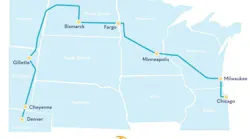
DCN, Range, and WIN Technology are building a high‑capacity fiber network to meet the growth needs of hyperscaler AI providers—reflecting the latest effort to fulfill hyperscaler needs outside of the increasingly crowded data center hubs.
Middle Mile Trends

While middle mile networks play a crucial role in delivering fast, affordable, and equitable broadband access to communities across North America, a new study by the Fiber Broadband Association (FBA) notes that rural areas face a significant shortage of middle mile infrastructure, which drives up the cost of internet access.
Electric Cooperative-backed Middle Mile

By employing Ribbon Communications, the electric cooperative enhances its bandwidth and raises network visibility.
Cable MSO Middle Mile

The cable MSO, which has continued to expand its metro and long-haul fiber routes, is seeing interest for 400G from its business and wholesale customers.