Clearfield’s $22M hyperscaler customer win validates its data center connectivity strategy
Key Highlights
- Clearfield secured a $22 million order from a hyperscaler customer for data center infrastructure, with shipments beginning in early 2027.
- The NOVA platform, recognized with a Gold award, is designed for high-density, scalable fiber management tailored to AI-driven data center needs.
- CEO Cheri Beranek emphasizes the company’s broadband expertise being effectively applied to the data center market, broadening its growth prospects.
- Despite broadband challenges like fiber shortages and regulatory delays, Clearfield remains committed to long-term fiber deployment solutions.
- The company’s revenue increased by 13% in the third-quarter fiscal 2026 quarter, though industry demand constraints led to a revised full-year sales outlook.
Keep up to date with Lightwave’s Q2 2026 earnings coverage.
You can check our publication’s key segments:
And
Here are other stories on Clearfield:
· Clearfield’s CEO said it is seeing an increase in data center engagements
· Clearfield’s CEO says it sees the Verizon/Frontier merger as a significant opportunity
· Clearfield solidifies a disciplined approach to data centers
· Clearfield charts long-term growth as the industry cadence becomes normalized
· Clearfield’s CEO says the BEAD program is a long-term growth catalyst
Clearfield has validated its efforts to carve out a niche in the exploding data center segment by securing a deal with a hyperscaler customer.
While the company did not reveal the customer’s name, the initial purchase order totals approximately $22 million. Clearfield expects shipments to begin in early fiscal 2027.
It is the first part of the first stage of the first building on this customer’s campus for this hyperscale environment.
Cheri Beranek, CEO of Clearfield, told investors during its third-quarter fiscal 2026 earnings call that the customer win validates its move to position its next phase of growth as a supplier to data center providers.
“While it is too early to predict the size or timing of future opportunities, this initial engagement demonstrates that our strategy is resonating with customers and broadening our addressable market,” she said. “We believe it represents an important step towards creating long-term shareholder value.”
Clearfield’s NOVA Platform earns Gold in 2026 ISE Network Innovators’ Awards
Clearfield’s NOVA Platform earned Gold honoree status in the 2026 ISE (a sister publication of Lightwave) Network Innovators’ Awards. The recognition comes amid Clearfield’s growing momentum in the data center market. The company recently announced a $22 million order to support a hyperscale data center project. NOVA, introduced earlier this year, combines high-density fiber management with tool-less installation, front-of-rack technician access, and modular scalability. The Gold honor reinforces Clearfield’s approach to making increasingly dense fiber environments simpler to deploy and manage as data centers and other network applications scale.
One key element was that Clearfield crafted a solution that fits the customer’s specific requirements, which led Clearfield to enhance its NOVA Platform.
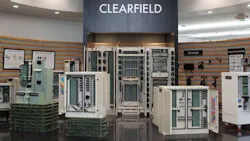
As a modular, high-density fiber ecosystem that includes patch panels and cassettes, NOVA is built to adapt to meet the needs of new AI-driven designs. These designs are driving an increase in fiber counts per rack, which places greater pressure on density, space, and day-to-day manageability.
“Equally important, we became involved early in the design process, working collaboratively to develop a connectivity solution tailored to the end user's deployment requirements,” Beranek said. “That collaboration led to an expansion of our NOVA platform with a new panel developed in conjunction with the customer, which we intend to standardize and introduce to the broader data center market later this calendar year. This approach reflects the same design principles that have differentiated Clearfield for years in broadband deployments.”
Adapting to data center needs
Clearfield, which has positioned itself in the data center industry with its NOVA platform, is adapting its experience building fiber cabinets for outside plant environments and central offices (CO) to the data center environment.
The company’s timing could not be better.
A recent Dell’Oro Group report revealed that worldwide Data Center Physical Infrastructure (DCPI) manufacturer revenue is projected to grow at a 22 percent compound annual growth rate (CAGR) from 2025 to 2030, reaching $120 billion by the end of the period.

Beranek said its message to the data center community about applying its broadband experience to data centers is resonating.
“We had a large group of people visit our Clearfield headquarters associated with the [data center] opportunity,” she said. “And one of the things that people will talk about is that the broadband marketplace has a lot of expertise, and that expertise is being pulled into the data center market.”
She added that “this is a wonderful example of how we can get started and just the opportunities within the data center to come.”
Broadband challenges remain
While Clearfield has set a new data center path, it continues to struggle in its broadband business because the uncertainty around the government’s BEAD funding program continues to influence customer planning.
The slower broadband deployment environment is reflected in its sales bookings for the quarter ending June 30, 2026.
“While states have made meaningful progress developing deployment plans, continued delays in federal approvals and funding disbursements are affecting both BEAD-funded and other commercial projects,” Beranek said. “These headwinds, combined with higher deployment, labor and material costs as well as the constraint of limited fiber availability, have resulted in a slower deployment environment and extended project timelines across much of the industry.”
In addition to BEAD uncertainty, the broadband industry is facing a fiber shortage.
While Clearfield started 2026 on a promising note with what it said was a strong backlog of bookings over the winter months, not having fiber means customers are waiting to move forward with new projects.
“While there is fiber activity happening in the market, it's predominantly with the national carriers; that's who's getting in the business or getting the fiber in the U.S.,” Beranek said.
She added that the fiber shortage is also being exacerbated by manufacturers dedicating more attention to the data center industry.
“The lack of fiber is actually not just in the carriers; it's because of the data centers that have got all the fiber,” Beranek said. “It's a frustrating situation: demand is there, but market availability to get the fiber to make it happen isn't.”
Despite near-term issues related to the BEAD program and fiber shortages for broadband providers, Clearfield remains confident it has the right solutions for the long-term fiber opportunity.
While the timing of broadband deployments remains uncertain, Clearfield noted it continues to invest in technologies that address its customers' challenges.
“By bringing fiber and power together, customers can reduce deployment complexity and create a more flexible foundation for future network growth,” Beranek said. “We believe this offering expands the role Clearfield can play in supporting our customers as their network needs continue to evolve.”

Sales rise, but constraints remain
Clearfield reported that net sales from continuing operations for the second quarter of fiscal 2026 increased 13% to $43.9 million from $38.8 million in the same year-ago quarter.
“The increase was driven by higher revenue across the majority of our customer markets,” said Daniel Herzog, CFO of Clearfield. “Revenue also increased 28% sequentially, reflecting the seasonal nature of our business.”
However, Clearfield's order backlog declined. As of June 30, Clearfield’s order backlog was $21 million, down $10.6 million, or 34%, from $31.6 million as of March 31, 2026. The June 30, 2026 order backlog balance reflects the removal of a previously booked order of $4.6 million that the company no longer expects to fulfill.
Due to industry demand constraints, Clearfield is cutting its outlook for fiscal 2026. The company expects net sales from continuing operations to be in the range of $151 million to $155 million, and net income per share to be in the range of $0.14 to $0.21.
Herzog said, “Industry demand constraints are forcing us to reduce our guidance for the full fiscal year 2026.”
For the fourth quarter of fiscal 2026, Clearfield expects net sales to be in the range of $38 million to $42 million and net income per share to be in the range of $0.00 to $0.07.
For related articles, visit the Business Topic Center.
For more information on high-speed transmission systems and suppliers, visit the Lightwave Buyer’s Guide.
To stay abreast of fiber network deployments, subscribe to Lightwave’s Service Providers and Datacom/Data Center newsletters.
About the Author
 Sean Buckley
Sean Buckley
Sean is the Editor-in-Chief of Lightwave. He establishes and executes Lightwave's editorial strategy across its website, email newsletters, events, and other information products. Before coming to Lightwave in July 2023, he served as editor of Broadband Communities. Earlier, he served as senior editor of FierceTelecom and the editor of the former Telecommunications Magazine. He got his start in the optical industry in 1998 when he became the editor of enterprise and optical networks at Information Gatekeepers. He has a BA in English from the University of Massachusetts, Boston, and lives in Dracut, Mass, with his wife, two sons, and his cat, Dove.