Dycom’s Q2 long-haul and middle-mile backlog surpasses $1B
Key Highlights
- Dycom's backlog for fiber projects exceeds $1 billion, highlighting strong industry demand for long-haul and data center interconnection services.
- Verizon's multi-billion-dollar fiber deal with Corning supports over 80 million miles of optical fiber through 2032, bolstering broadband and AI infrastructure.
- AT&T added over 1 million fiber locations in the second quarter, aiming for 60 million by 2030, reflecting aggressive FTTH deployment strategies.
- Lightpath is expanding fiber to hyperscale data centers in Michigan and Wisconsin, supporting the growth of AI-grade infrastructure.
- Dycom's fiber-to-the-home revenue grew 60% year-over-year, driven by large providers' accelerated FTTH buildout programs.


Dycom has high hopes for the data center market. Previously, the company forecast that spending on outside plant data center network infrastructure would exceed $20 billion over the next 5 years alone.
“The $20 billion we framed out over a year ago is fiber-in-the-ground to connect data centers nationwide ultimately,” Peyovich said. “We talked about it as long-haul, middle mile and inside fiber. We've had hundreds of millions of dollars of work in place because we've been working on it for almost a couple of years now.”
He added that “when we talk about over $1 billion backlog, we're not talking about data center-related work, but “pure fiber that's ultimately going to connect data centers.”
FTTH rising
Middle mile builds weren’t the only growth engine in the second quarter for Dycom.
Dycom also saw its communications results boosted by a 60% increase in FTTH buildouts, driven by large service providers accelerating fiber-to-the-home (FTTH) builds to meet rising speed demands.
The telecom construction company continues to benefit from aggressive build-out strategies by Tier 1 and Tier 2 broadband service providers. Customers continue to scale multiyear fiber-to-the-home deployment programs.
“Our fiber-to-the-home revenue grew 60% year over year in the first half,” Peyovich said. “Last year, we talked about passing millions of homes. The passings and revenues don't directly correlate, but you're talking about significant growth and really a very large presence for Dycom across the space.”
Dycom’s confidence likely reflects the growth of Tier 1 providers like AT&T and Verizon, which saw strong customer growth in their FTTH network customer bases in the second quarter.
AT&T added over 1 million fiber locations in the second quarter, targeting 40 million by 2026 and 60 million by 2030. The company plans to build 8 million new fiber locations this year, including 4 million from the Lumen acquisition.
Likewise, Verizon remains aggressive with its fiber broadband plans.
With its acquisition of Frontier behind it, Verizon recently announced a large-scale fiber deal with Corning. The multi-billion-dollar agreement with Corning secures over 80 million miles of high-density optical fiber through 2032 to support broadband and AI infrastructure.
To complement its current build plans, Verizon’s fiber expansion includes acquisitions and partnerships, such as with Frontier and Ripple Fiber, to pass up to 50 million premises and grow its customer base.
“All of our customers reinforced their FTTH build program this quarter,” Peyovich said. “We feel very confident in that, and you can see it in our results.”
He added that “I wouldn't talk about necessarily increased spending, but everybody continues to be on track and on target and you can see Dycom capitalizing on that.”
Customer diversification drives revenue mix
Dycom reported that total contract revenues of $2.01 billion grew 45.6% over the second quarter of last year, reflecting what the company said is the strength of relationships and continued diversification across its customer base.
Driven by robust fiber-to-the-home programs, increased long-haul and middle-mile fiber infrastructure builds and growing maintenance and operations services, Communications revenue was $1.608 billion and grew 16.7% organically.
The company said that its Building Systems segment grew significantly, representing approximately 20% of total revenue for the quarter. Building Systems’ total contract revenues of $397.5 million exceeded expectations as the segment continues to grow rapidly.
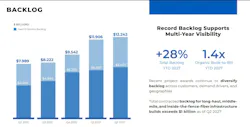
Dycom’s total backlog at the end of the second quarter was $12.2 billion, including $11 billion of Communications backlog and $1.26 billion Building Systems backlog. The company expects backlog to be completed in the next 12 months to be $6.5 billion, including $5.4 billion from Communications and $1.1 billion from Building Systems.
For the Communications segment, Dycom expects contract revenues of $5.9 billion to $6.01 billion, reflecting the deferral of about $150 million of wireless revenues into Fiscal Year 2028 versus prior expectations.
For the Building Systems segment, we are increasing our outlook and now expect contract revenues ranging from $1.58 billion to $1.65 billion, including approximately $90 million of acquired revenue from National Technology Integrators in the second half of the fiscal year.
H. Andrew DeFerrari, CFO of Dycom, said that Building Systems “exceeded our expectations as we continue to experience rapid growth in this segment.”
Dycom also benefited from its acquisition of National Technology Integrators, which specializes in inside-plant structured cabling, including within data centers, as well as advanced audio-visual and security systems, with operations spanning Washington, D.C., Maryland, Virginia, Texas, and the Midwest.
The acquired business performed well and contributed approximately $22.9 million of revenue during the quarter.
Looking toward the third quarter, Dycom expects total contract revenues of $1.9 billion to $1.98 billion.
“With a strong first half of the year completed and momentum across the business, we are confident in our ability to execute our strategy as we pursue the significant and growing opportunities ahead,” DeFerrari said.
For related articles, visit the Business Topic Center.
For more information on high-speed transmission systems and suppliers, visit the Lightwave Buyer’s Guide.
To stay abreast of fiber network deployments, subscribe to Lightwave’s Service Providers and Datacom/Data Center newsletters.