FBR Solutions deepens broadband outside plant capabilities with Southeastern Cable acquisition
Key Highlights
- The acquisition of Southeastern Cable expands FBR's footprint in North Carolina, South Carolina, Virginia, and Georgia, strengthening its outside plant services.
- Southeastern Cable offers comprehensive broadband construction, including aerial and underground cable placement, fiber and coaxial splicing, and permitting.
- FBR's strategic acquisitions, including RTS Associates and Johnson Communications, enhance its capabilities in telecommunications design, engineering, and rural fiber deployment.
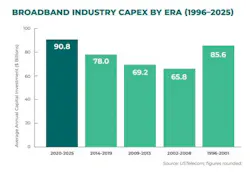
- The move aligns with the nationwide increase in broadband investments, with providers spending over $92 billion in 2025 to modernize and expand networks.
- FBR aims to position itself as a competitive alternative to larger players by operating locally and expanding its regional network construction expertise.

FBR Solutions has taken another step to strengthen its outside plant service arsenal by agreeing to acquire Southeastern Cable Contractors.
By acquiring Southeastern Cable Contractors, FBR strengthens its outside plant construction capabilities and expands its footprint across North Carolina, South Carolina, Virginia, and Georgia.

Southeastern Cable, which offers end-to-end broadband construction — spanning aerial and underground cable placement, drop bury, fiber and coaxial splicing, and permitting and engineering—will continue to operate under its established name and local leadership as part of the FBR platform.
Since its founding in 2008, Southeastern Cable has completed millions of feet of subsidy-funded construction, including BEAD- and RDOF-backed deployments.
Southeastern Cable will continue to operate under its established name and local leadership as part of the FBR platform.
Matthew Glass, CEO of FBR Solutions, said, “The craftsmanship, the customer relationships, and the reputation this team has built in the Mid-Atlantic are exactly what make this combination worth doing.”
Focus on broadband
The acquisition of Southeastern Cable reflects FBR’s continued investment in building a platform capable of supporting the accelerating pace of broadband infrastructure investment nationwide.
According to US Telecom’s 2025 Broadband Capex Report, broadband providers invested $92.6 billion in 2025 to expand, upgrade and modernize America’s communications infrastructure.
The report found that in 2025, providers extended an era of historically high broadband industry investment — expanding rural reach, modernizing wireless networks, adding capacity, and pushing fiber deeper into communities.
And with service providers of all sizes expanding their fiber broadband and cable footprints through private and public funding sources like BEAD, FBR will have an even deeper set of capabilities to respond as network builds ramp through the rest of 2026 and into 2027.
Scaling through acquisitions
FBR continues to ramp up its portfolio of capabilities via targeted acquisition of other regional network construction companies.
Last July, FBR Solutions acquired RTS Associates, further expanding its national capabilities in telecommunications design, engineering, and turnkey deployment.
Similar to Southeastern Cable, RTS enhanced the company’s ability to deliver end-to-end network solutions at scale and reinforced its position in the broadband infrastructure space. RTS Associates provides telecommunications design and engineering services to major telecommunications operators, municipalities, EMCs, CATV, and wireless carriers. RTS brought 250 North American employees to FBR.
Earlier, its acquisition of Johnson Communications enhanced FBR’s ability to serve telephone and utility cooperatives, both of which have been rapidly expanding their fiber broadband capabilities in rural areas.
Johnson has pioneered rural fiber deployment through its fully integrated solutions and has deployed over 100 in-house construction crews.
By adding more capabilities to its portfolio and continuing to operate them locally, FBR will be positioned as an alternative network construction source to larger players like Dycom and others that build broadband network infrastructure.
For related articles, visit the Broadband Topic Center.
For more information on high-speed transmission systems and suppliers, visit the Lightwave Buyer’s Guide.
To stay abreast of fiber network deployments, subscribe to Lightwave’s Service Providers and Datacom/Data Center newsletters.
About the Author
 Sean Buckley
Sean Buckley
Sean is the Editor-in-Chief of Lightwave. He establishes and executes Lightwave's editorial strategy across its website, email newsletters, events, and other information products. Before coming to Lightwave in July 2023, he served as editor of Broadband Communities. Earlier, he served as senior editor of FierceTelecom and the editor of the former Telecommunications Magazine. He got his start in the optical industry in 1998 when he became the editor of enterprise and optical networks at Information Gatekeepers. He has a BA in English from the University of Massachusetts, Boston, and lives in Dracut, Mass, with his wife, two sons, and his cat, Dove.