Verizon, according to a Financial Times (FT) report, is negotiating a $6 billion deal to acquire fellow fiber broadband provider Fidium and expand its fiber broadband footprint.
According to the FT report, Verizon has begun discussions with Fidium’s owners, Searchlight Capital Partners and British Columbia Investment Management.
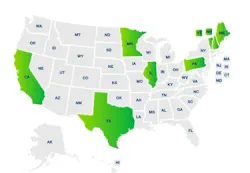
If Verizon does purchase Fidium, the service provider will expand its presence in 21 states, including California and Texas. Additionally, Verizon would regain its presence in northern New England by adding a subscriber base of 351,000 homes across Maine, New Hampshire, and Vermont. Previously, Verizon sold off its northern New England assets to FairPoint, which was later acquired by Consolidated (the former brand of Fidium) in 2017.
Fidium itself also has ambitious fiber expansion plans. The service provider plans to make its fiber broadband service available to up to 2 million homes nationwide by the end of 2027.
Although discussions between Fidium’s owners and Verizon continue, a deal is unlikely to be finalized for several weeks.
As seen with other large-scale acquisitions, FT noted it is also possible that another service provider could make a bid for Fidium. Also, there’s the possibility that no deal could come to fruition.

All about expansion
A key element of Verizon’s proposed acquisition of Fidium is scale.
Verizon expects to end 2026 with more than 32 million fiber passings, with 55% of fiber customers subscribing to 1 Gbps or higher speed plans. With Frontier in its pocket, the service provider has raised the number of homes it plans to pass with fiber to 35 million to 40 million to 40 to 50 million.
The service provider plans to pass fiber to 40 to 50 million homes, supported by acquisitions and partnerships like Tillman Global Holdings.
In October, Bain Capital and Tillman Global Holdings completed their previously announced $1.5 billion investment in Eaton Fiber, a Tillman affiliate, and Eaton Fiber’s acquisition of Ripple Fiber.
Dan Schulman, CEO of Verizon, told investors during its fourth-quarter earnings call that to meet its fiber expansion goals, particularly in markets outside its traditional fiber-to-the-home (FTTH) footprint, the service provider is considering potential acquisitions and partnerships. Last October, Verizon inked a deal with Eaton Fiber, an affiliate of Tillman Global Holdings, to target serviceable addresses in new markets.
An acquisition of Fidium provides access to fiber in over 20 states via a network spanning 76,000 to 78,000 route miles. The network includes millions of homes, apartment units, and commercial buildings that Fidium's fiber network can directly reach. 1.5 million of these locations can provide internet service at a speed of 1Gbps or faster.
“We said in our CapEx guidance that we'll do at least 2 million organically, so we'll look at the possibility of both inorganic and partnerships,” Schulman said.
Boosting convergence
Like its acquisition of Frontier, if Verizon moves forward with an acquisition of Fidium, it would also have another set of new customers to drive home its wireline/wireless bundled convergence strategy.
With Fidium, Verizon would gain access to a larger market of homes and businesses that don’t currently subscribe to Verizon’s wireless services. Existing Fidium FTTH and even business customers would be able to get a service bundle that includes wireless services.
Fellow telco AT&T, which completed its acquisition of Lumen’s consumer fiber assets earlier this year, noted in its fourth-quarter earnings call that it expects the convergence rate to reach 50%, driven by fiber and wireless integration, as part of a broader industry realignment towards bundled services.
Offering a converged fiber-and-wireless bundle is one way for traditional providers like Verizon and AT&T to compete, as their cable competitors continue to raise the stakes by growing their wireless bases and bundling services.
While the two largest cable operators—Charter and Comcast—continued to bleed broadband customers into the third quarter, the cable MSOs added a notable 508,000 and 368,000 mobile lines, respectively.
Both providers have continued to tout their convergence strategies.
Comcast convergence combines Xfinity home broadband, wireless service (Xfinity Mobile), and over 23 million Wi-Fi hotspots into a single connected experience. The company emphasizes wireless as a central component of its convergence strategy, with plans to convert free lines into paid relationships.
Likewise, Charter pairs Spectrum Internet with Spectrum Mobile (using its wholesale MVNO agreement with Verizon and commercial wholesale deal with T-Mobile).
Business, wholesale service implications
While a move for Fidium would expand its consumer fiber footprint, this potential acquisition has implications for Verizon’s business services and wholesale aspirations.
In addition to being one of the largest consumer fiber providers, Verizon is a major supplier of business and wholesale services.
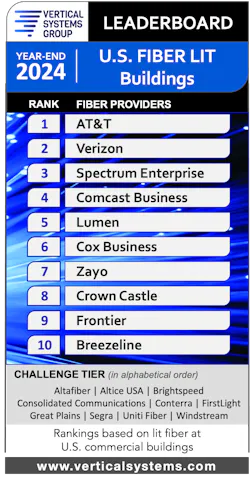
Verizon has a large base of fiber-enabled buildings. Trailing only AT&T, Verizon was ranked second on Vertical Systems Group’s 2025 2025 U.S. Fiber Lit Buildings LEADERBOARD. By adding Fidium into its fiber portfolio, Verizon would immediately increase its on-building fiber footprint to serve more businesses and data center providers.
VSG noted that in 2025 the installed base of fiber-lit commercial buildings and Data Centers reached nearly two million sites.
Data centers have become another target for both Verizon and Fidium, as the need for fiber to connect them is becoming more acute.
RVA noted in its five-year forecast that 92,000 route miles of fiber need to be built for data centers.
Mike Render, president of RVA, said that while the data center industry emphasized power, cooling, and silicon, “there’s not enough fiber between existing centers and the new data centers.”
Verizon, through a large-scale supply deal with Corning, secured over 80 million miles of high-density optical fiber through 2032 to support broadband and AI infrastructure.
Through Verizon’s AI Connect strategy, the company is deploying ultra-dense cables across major long-haul corridors to connect data centers directly. AI Connect was launched in 2025 under former Verizon CEO Hans Vestberg.

But data center fiber demand is also creating wholesale opportunities for Tier 2 providers like Fidium, which built 9,000 new fiber route miles in 2025, with its total wholesale network spanning more than 76,000 route miles and over 380,000 on-net and near-net buildings.
Fidium extended its reach to Flexential’s data centers in Dallas and Plano, Texas, and Minneapolis–St. Paul, Minnesota.
As Fidium looks to expand its network across Minnesota, Texas, and other states to serve data center providers such as Flexential, it is considering how potential customers can connect to the network.
“Edging out our network is opportunity-driven, and the data center landscape is the obvious place to go,” said Sean Baillie, SVP of Carrier, Channel, Data Center, and Hyperscale at Fidium. “We’re putting in a lot of money into data center expansion,” Baillie said.
For related articles, visit the Business Topic Center.
For more information on high-speed transmission systems and suppliers, visit the Lightwave Buyer’s Guide.
To stay abreast of fiber network deployments, subscribe to Lightwave’s Service Providers and Datacom/Data Center newsletters.
About the Author
 Sean Buckley
Sean is the Editor-in-Chief of Lightwave. He establishes and executes Lightwave's editorial strategy across its website, email newsletters, events, and other information products. Before coming to Lightwave in July 2023, he served as editor of Broadband Communities. Earlier, he served as senior editor of FierceTelecom and the editor of the former Telecommunications Magazine. He got his start in the optical industry in 1998 when he became the editor of enterprise and optical networks at Information Gatekeepers. He has a BA in English from the University of Massachusetts, Boston, and lives in Dracut, Mass, with his wife, two sons, and his cat, Dove.