Charter’s Cox deal empowers its business services reach, service capabilities
Key Highlights
- Charter's acquisition of Cox includes key assets like Segra and RapidScale, enhancing its fiber and cloud service offerings.
- The merger adds over 61,000 on-net commercial buildings and 632,000 fiber 'near-net' locations, significantly expanding Charter's network reach.
- Charter is positioned to lead in on-net fiber rankings and Ethernet market share, with major industry mergers expected to reshape the landscape in 2026.
- The combined company aims to grow its wireless business, leveraging existing relationships with Verizon and T-Mobile to cross-sell services to enterprise clients.
- Industry analysts predict major shifts in fiber and Ethernet provider rankings due to recent and upcoming acquisitions, with Charter poised for significant growth.
Here’s a quick roundup of the key M&A deals announced in 2025:
· AT&T sets path to reach 60M fiber locations by 2030 with Lumen fiber business acquisition
· Charter and Cox $34B merger creates a broadband and business service powerhouse
· Verizon snaps up Frontier for $20B in bid to bolster fiber broadband base
· Zayo deepens metro fiber scale with $4.25B Crown Castle’s fiber solutions acquisition
With the acquisition of Cox under its belt, Charter will further solidify its position in the medium- and large-business services space, traditionally dominated by ILECs like AT&T and Verizon.
The combination of Charter and Cox creates a more powerful business service provider with a larger fiber network and more service assets.
“Businesses of all sizes throughout the Spectrum footprint will benefit from the combination of Spectrum Business with Cox Business’ well-known industry leadership, including Segra, Cox’s super-regional, fiber-based provider serving commercial enterprise and carrier customers, and RapidScale, its managed, cloud-based services provider,” Charter said in a release announcing the completion of its Cox deal.
In the near term, Charter is already making an impact in the enterprise services market, as shown in its second-quarter earnings.
Charter said during its second-quarter earnings call that “total commercial revenue grew 1.5% year over year, with mid-market and large business revenue up 2.8%, and when excluding all wholesale revenue, mid-market and large business revenue grew by 3.5%.”

The Segra and RapidScale factor
Charter’s acquisition of Cox includes Segra, a regional, fiber-based provider serving commercial enterprise and carrier customers, and RapidScale, its managed, cloud-based services provider.
According to an SEC filing, Charter paid $3.5 billion in cash for Segra and RapidScale, which is structured separately from the equity consideration used for the residential cable business.
Christopher Winfrey, CEO of Charter, said RapidScale and Segra will continue to operate as part of its broader business services portfolio.
“I think a bigger opportunity for both RapidScale and for Segra is where there is overlap inside of some of the Spectrum network footprint,” he noted. “I think there’ll be more selling opportunities for both as a function of our size and bringing them together. And we’re going to leverage the expertise that we have with Cox Business, the Spectrum Business, to continue to grow those businesses.”
Cox acquired Segra's commercial business in October 2021 and later combined it with Unite Private Networks to operate as a standalone fiber infrastructure company under the Segra brand.
Segra brings many complementary business assets to Charter.
The standalone company serves over 20,000 connected customer locations in 24 states across 44,000 fiber-route miles. Segra itself has also been actively enhancing its network, making targeted acquisitions like Everstream’s all-fiber network in the St. Louis metropolitan area, which added nearly 1,000 route miles to its network.
Winfrey said there are no plans to change how those businesses are operated, including leadership. “I think a bigger opportunity for both RapidScale and for Segra is where there is overlap inside of some of the Spectrum network footprint,” he noted. “I think there’ll be more selling opportunities for both as a function of our size and bringing them together. And we’re going to leverage the expertise that we have with Cox Business, the Spectrum Business, to continue to grow those businesses.”
Scaling on-net fiber
As Charter has expanded the reach of business service footprints, the service provider has continually connected more business buildings to its network.
By acquiring Cox, Charter gains over 61,000 on-net commercial buildings and 632,000 fiber "near-net" buildings across its national footprint. Additionally, it will be able to leverage an additional 2.4 million on-net hybrid fiber-coax business locations.
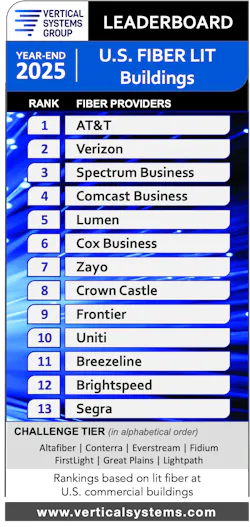
Charter, Cox and, more recently, Segra have consistently been cited for their leadership in on-net business fiber by Vertical Systems Group.
On VSG’s Year-end 2025 Fiber Lit Buildings LEADERBOARD, Charter ranked third while Cox Business was at 6 and Segra was at 13. The research firm’s 2025 leaderboard included 13 providers with over 25,000 fiber-lit sites, highlighting significant industry growth and focus on high-speed connectivity.
Acquisitions by Charter and, earlier, AT&T, Verizon, and Zayo could alter the on-net fiber rankings. AT&T completed its purchase of Lumen’s Mass Markets fiber business while Verizon wrapped up its acquisition of Zayo’s fiber solutions assets.
At the time VSG put together its last fiber-lit LEADERBOARD, it said: “several LEADERBOARD providers have already completed or are planning mergers that will be reflected in our next analysis.”
Ethernet market shakeup
With access to more on-net fiber and HFC assets, Charter will also enhance its Ethernet service capabilities.
In 2026, the Ethernet market is shifting as a group of key acquisitions is completed. AT&T, Charter, Verizon and Zayo all purchased assets that will advance their network reach and service capabilities with an expanded set of fiber assets.
Like its ranking in the on-net fiber arena, Charter’s Spectrum Business and Cox Business have been sizeable players in the U.S. Carrier Ethernet market. Now as a combined company, Charter will have even greater Ethernet capabilities.
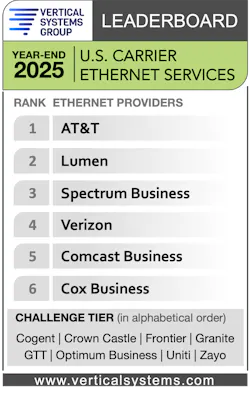
Charter and Cox ranked third and sixth, respectively, on the 2025 U.S. Carrier Ethernet year-end LEADERBOARD.
The research firm noted that the U.S. Ethernet market rankings will change significantly this year because a quarter of large acquisitions—including AT&T, Verizon, and Zayo—were completed this year.
“While the U.S. Ethernet Leaderboard remained unchanged through 2025, we expect major reshuffling in 2026,” said Rick Malone, principal of Vertical Systems Group. “Top provider rankings will shake up this year due in part to Verizon’s now-completed acquisition of Frontier, Zayo’s impending acquisition of Crown Castle’s fiber business, and by mid-2026, Charter is expected to complete its acquisition of Cox.”
The business wireless factor
While wireline Ethernet and managed services will remain a cornerstone of the combined company, the merger also creates greater opportunities for Charter to sell wireless services to more businesses.
Having already built a growing wireless customer base in its residential and small business segment through its relationship with Verizon Wireless, one that had over 12.5 million customers as of the end of the second quarter, Charter sees potential to advance further in the broader business market it serves.
During the second quarter, Charter added over 400,000 Spectrum Mobile lines, bringing total lines to 1.7 million over the last 12 months and representing 16% growth.
“We now have over 12.5 million mobile lines and remain the fastest-growing mobile provider in our footprint,” Winfrey said.

Last August, Charter struck a deal with T-Mobile to deliver mobile services to its array of small and larger business customers. Separately, fellow cable MSO Comcast also struck a similar deal with T-Mobile for its business customer base.
The provider’s move comes as its traditional telco competitors—namely AT&T and Verizon—are increasing their wireless revenue share with business customers.
Charter debuted its wireless service for businesses earlier this year.
Winfrey said during its second-quarter earnings call that it will start enhancing its wireless service for businesses with various elements that will allow it to penetrate more accounts. It could potentially cross-sell its new wireless services to existing Cox Business customers.
“We've recently launched on the B2B side, incrementally going forward with T-Mobile, also obviously, a fantastic network in a capital-light approach for us that makes a lot of sense,” he said. “But we're also able to add in some additional features and product features into the business side that we didn't have before, as well as the ability to sell a lot more lines and move upstream into that space.”
For related articles, visit the Business Topic Center.
For more information on high-speed transmission systems and suppliers, visit the Lightwave Buyer’s Guide.
To stay abreast of fiber network deployments, subscribe to Lightwave’s Service Providers and Datacom/Data Center newsletters.
FOR FURTHER READING
 chtrcox_01_hero
 1
1 calnet_01_altimage
 spectrum_mobile_logo_vert_r_rgb_0
About the Author
 Sean Buckley
Sean Buckley
Sean is the Editor-in-Chief of Lightwave. He establishes and executes Lightwave's editorial strategy across its website, email newsletters, events, and other information products. Before coming to Lightwave in July 2023, he served as editor of Broadband Communities. Earlier, he served as senior editor of FierceTelecom and the editor of the former Telecommunications Magazine. He got his start in the optical industry in 1998 when he became the editor of enterprise and optical networks at Information Gatekeepers. He has a BA in English from the University of Massachusetts, Boston, and lives in Dracut, Mass, with his wife, two sons, and his cat, Dove.