AT&T’s CEO says a large majority of U.S. data centers are close to its fiber network


AT&T has become a key network supplier partner to the largest hyperscaler providers, showing how its far-reaching network can meet business customers' growing cloud needs.
John Stankey, CEO of AT&T, told investors during its third-quarter earnings call that its proximity to U.S. data centers makes it a viable connectivity option.
“Over 90% of mapped US data centers are within 10 miles of our fiber and over 80% are within 1 mile,” he said. “This is one reason the nation's leading hyperscalers work with AT&T to support their rapidly growing high-capacity connectivity needs, including AWS, which uses AT&T to connect their locations with high-capacity fiber.”
In February, AT&T introduced AWS Interconnect – a last-mile connectivity offering delivered in collaboration with Amazon Web Services (AWS) that brings AT&T’s fiber and fixed wireless connectivity directly into AWS environments.
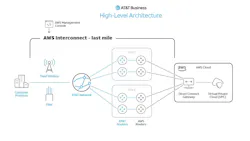
As a streamlined service offering, AWS Interconnect – last mile embeds AT&T‑delivered connectivity directly into AWS workflows, designed to enable customers to provision and manage last‑mile connectivity within the AWS environment and lays the foundation for the use of AI agents to monitor and manage the AI experience from the user to the cloud.
Besides AWS, AT&T is also working with Microsoft to support high-capacity needs as AI drives new demands.
Stankey said its relationship with AWS and Microsoft “is simply foundational to drive sustainable value by layering high-margin services and network intelligence on top of that fiber to connect growing AI workloads across the entire ecosystem, including business endpoints, metro aggregation, and managed multi-vendor cloud ingress and egress.”
Supporting enterprise AI transitions
As AT&T looks to support its enterprise customers’ transition to AI, the service provider is working to help customers support the rise in workloads moving to the cloud with fiber and fixed wireless capacity.
Enterprises are operating in what Stankey says is a hybrid environment, running traffic over both their fixed and mobile infrastructure. A fiber-fed infrastructure will support this by tracking packets across both fixed and mobile networks and delivering a high-quality service.
“Enterprises are running traffic across multiple cloud layers,” he said. “And what they need to be able to do is to ensure that certain applications that have higher requirements for performance are consistently managed across both those networks and across multiple cloud fabrics.”
During discussions with enterprise customers, AT&T focuses on ensuring network performance whether it is running fiber or wireless. The service provider will tag and mark performance-level packets to ensure applications running in both environments can maintain a high level of service consistent with the performance required for AI-driven applications or capabilities.
“AI-driven applications or capabilities often have more stringent requirements for latency and round-trip performance,” Stankey said. “If you're doing inference, you need quicker response times, and people want that performance, and they're doing more of it, so they just need more sheer capacity, and that's part of what's driving the lift.”
Based on ongoing conversations with enterprises, AT&T expects to see more demanding applications, including the emergence of robotics and warehouses automating more of their functions.
Stankey said another investment level will likely be required, which “will be managed networks that will be necessary given the performance requirements that are essential to allowing that to happen.”
Another element AT&T can tout in serving enterprises’ AI movement is how its network connects to a large number of metro areas. Just as it tracks enterprise network performance, the service provider will do the same for its metro networks and their connections to cloud providers.
“We've invested heavily at the edge in endpoints, both in our wireless and fixed businesses,” Stankey said. “We have a fantastic metro-to-metro infrastructure, as you might imagine, based on the nature of our network and how we operate. What we want to make sure of is that, for our backbone in and out of those metros that hit those cloud fabrics, we have absolute visibility into how we do that ingress and egress.”
He added that by “involving ourselves with the hyperscalers that are driving most of the workloads in that space, that makes sure that we have the right expressways or on-ramps in and out of their clouds so that our metro and the endpoint networks that we've built and invested in so heavily can have that end-to-end visibility and end-to-end performance.”
Keep up to date with Lightwave’s earnings coverage.
You can check our publication’s key segments:
And
Here’s other news on AT&T:
· AT&T’s CEO says it has strategies to attract more converged customers
· AT&T sets plan to reach 8M new fiber locations in 2026
· AT&T’s CEO says convergence is part of the structural realignment of the telecom industry
· AT&T’s Lumen fiber deal could boost its converged business services outlook
· AT&T’s CEO says its scalability enables agility in its fiber build
Advanced business revenue ramps
As seen in earlier quarters, AT&T continues to balance next-gen gains with ongoing declines in its legacy TDM business lines.
AT&T saw Business Fiber and Advanced Connectivity rise 8.7% to nearly $2 billion, while Business Transitional and Other services dipped 14.6% to $1.02 billion.
“We achieved solid growth across wireless, fiber, and fixed wireless, which is now consistently offsetting structural pressures on transitional services such as VPN and wholesale,” said Pascal Desroches, AT&T CFO.
AT&T has been improving its sales execution across direct, indirect, and digital channels, with greater penetration of fiber and fixed wireless.
Stankey said that its “broad and deep fiber network also has us well positioned to be a leader in AI-grade connectivity.”
For related articles, visit the Business Topic Center.
For more information on high-speed transmission systems and suppliers, visit the Lightwave Buyer’s Guide.
To stay abreast of fiber network deployments, subscribe to Lightwave’s Service Providers and Datacom/Data Center newsletters.
About the Author
 Sean Buckley
Sean is the Editor-in-Chief of Lightwave. He establishes and executes Lightwave's editorial strategy across its website, email newsletters, events, and other information products. Before coming to Lightwave in July 2023, he served as editor of Broadband Communities. Earlier, he served as senior editor of FierceTelecom and the editor of the former Telecommunications Magazine. He got his start in the optical industry in 1998 when he became the editor of enterprise and optical networks at Information Gatekeepers. He has a BA in English from the University of Massachusetts, Boston, and lives in Dracut, Mass, with his wife, two sons, and his cat, Dove.
Related

 istock_000021119423small